Description
️ 🖼Tool Name:
Repowise
🔖 Categories:
- Programming and Development
- Code Generation and Review
- Documentation and Software Development Toolkits
- DevOps, CI/CD, and Monitoring
- Testing and Quality Assurance
- Integrations and APIs
- Automation and Smart Agents
- Business and Operations Management
️ ✏What does this tool offer?
Repowise offers a software intelligence platform that combines open source,hosted SaaS, and an enterpriseoption .It aims to provide reusable context around the codebase for AI agents, helping to reduce code duplication, detect code quality issues and risks associated with changes before they are implemented, and generate architectural documentation that is directly linked to the code and updates alongside it.
The platform indexes the source structure, dependencies, call relationships, Git history, ownership, code health indicators, tests, and engineering decisions, then uses this unified index to provide accurate context to development agents via CLI and MCP. It can also generate documentation for the architecture, modules, and files associated with the source code, and analyze the risks of changes based on the scope of impact, dependencies, historical shared changes, and test gaps, as well as assess risks related to defects, maintainability, and performance, and identify files that need improvement.
Repowise provides a GitHub PR Bot to review changes against the indexed codebase, dependency graphs, and change history, while detecting affected contracts, missing shared changes, and adding repository-based checks within merge request workflows.
The platform includes features such as Code Health,Agent Provenance,AI Context (MCP),Change Risk,Security,Auto Wiki,Git Intelligence, andArchitecture (C4)and Decisions, as well as specialized tools and guides for code health, AI context and MCP, Git intelligence, change risk, architecture, Auto-Wiki, ADR decisions, and agent provenance.
Repowise can be run locally as open source under the AGPL-3.0 license,with the ability to integrate tools via MCP while maintaining control over the operating environment and model provider. It can also be used as a hosted service to browse public repositories, while the Enterprise option provides organizations with the ability to run the platform with controls, support, and a deployment model tailored to their environment.
Repowise delivers benchmark results including 0.876 for file coverage, achieving first place on ContextBench across 42 closed test cases using Python and Go, and a31.6% reduction in agent cycle time in a test on django/django at a specific commitment point, anda 0.74 ROC AUC in defect prediction across 21 repositories, 9 languages, and 2,826 files.
⭐ What does it actually offer based on user experience?
- A unified, reusable context for AI agents.
- Indexing the code base structure, dependencies, and call relationships.
- Analyzes Git history, ownership, tests, and engineering decisions.
- Identifying code health issues and files that need improvement.
- Analyzing the risks of changes before they are implemented.
- Identify the scope of a change’s impact and its associated dependencies.
- Identifying test gaps and historical shared changes.
- Generate architectural documentation and documentation for modules and files associated with the code.
- Provide Auto Wiki for documenting the code base.
- Provide Architecture (C4) and ADR decisions.
- Provide a Dependency Graph with five view modes in the free plan.
- Detect hotspots and dead code.
- Analyze code ownership andBus Factor.
- Explore symbols using the Symbol Explorer.
- Review pull requests via the GitHub PR Bot.
- Use AI Context via MCP.
- Provide Agent Provenance to track the origin of the information used by the agent.
- Support for CVE-compliant dependency scanning in applicable plans.
- Provide function-level reachability and secret discovery across the entire Git history in Pro and Teams.
- Export SBOM and VEX in CycloneDX format in Pro and Teams.
- Provide Jira and Confluence integrations in Teams.
- Ability to browse public repositories without an account.
- Support for private repositories in eligible paid plans.
🤖 Does it include automation?
Yes, Repowise includes automation geared toward software development and code analysis. The platform indexes repositories and analyzes their structure, dependencies, Git history, tests, and ownership, then uses the resulting information to provide automated context to development agents via CLI and MCP.
It also provides a GitHub PR Bot to automatically review changes against the indexed codebase, detect affected contracts, shared changes, and test gaps within Pull Request workflows. Paid plans also offer index synchronization on every push and AI-generated documentation, while Teams enables team-level PR review across repositories and Portfolio Health dashboards.
This automation does not mean that Repowise automatically implements code changes; rather, the information provided focuses on cataloging, analyzing, and understanding the codebase, as well as providing context, review, and documentation.
💰 Pricing Model:
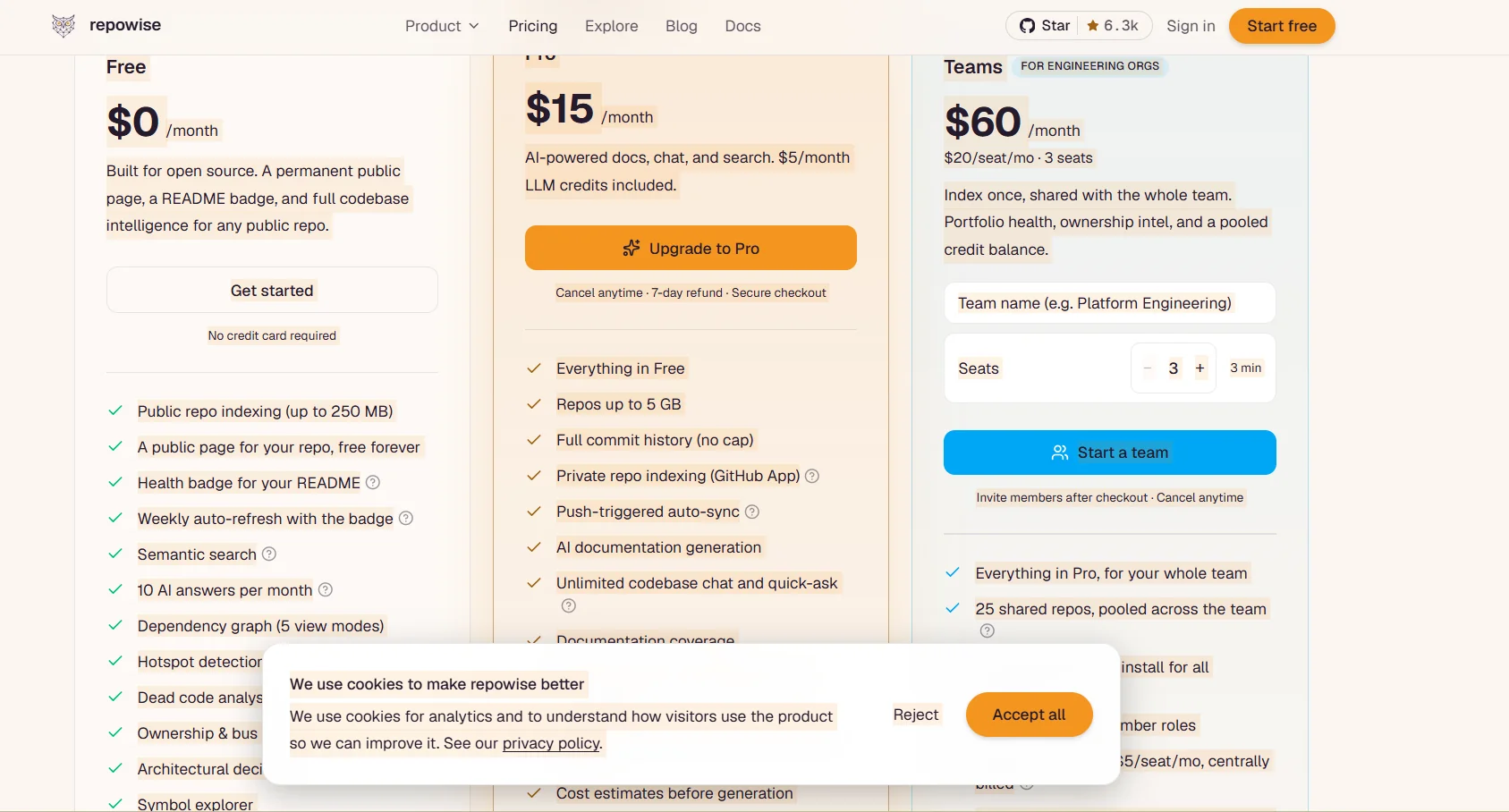
Freemium — Repowise offers an open-source, self-hostable core under the AGPL-3.0license, along with a hosted service that includes Free, Pro, and Teamsplans, and a custom-priced Enterprise plan.
🆓 Free Plan Details:
| Feature | Details |
|---|---|
| Price | $0 per month |
| Credit Card | No credit card required |
| Public Repositories | Indexing up to 250 MB |
| Public Repository Page | Free Forever |
| README | Repository Health Badge |
| Index Update | Weekly |
| Search | Semantic Search |
| AI Answers | 10 answers per month |
| Dependency Graph | 5 Display Modes |
| Hotspots | Available |
| Dead Code | Available |
| Ownership and Bus Factor | Available |
| Architectural Decisions | Available |
| Symbol Explorer | Available |
| Git Commits | Analyze up to 500 commits |
| Push Sync | Not available |
| AI Documentation | Not available |
| Unlimited AI Responses | Not available |
| Full Commit History | Not available |
💳 Paid Plan Details:
| Plan | Price | Features and Differences |
|---|---|---|
| Pro | $15 per month | All Free features, up to 5 GB of repositories, unlimited full commit history, private repository indexing via the GitHub App, synchronization on every push, AI-generated documentation, unlimited Codebase and Quick-Ask chats, documentation coverage tracking, $5 in LLM credits per month, with the option to purchase additional $5 packs that never expire, and support for Anthropic, OpenAI, and Gemini keys |
| Teams | $60 per month for three seats, or $20 per seat | All Pro features for the team, 25 shared repositories, one GitHub App installation per organization, Owner, Admin, and Member roles, a shared LLM credit of $5 per seat per month, team-wide PR review across all repositories, Portfolio Health dashboards, Ownership and Bus Factor analytics, cross-repository workspaces, Jira and Confluence integrations, up to 6 concurrent indexing operations, and a daily LLM limit of $100 |
| Enterprise | Custom pricing with annual contracts | Private Cloud or On-Premise deployment, support and custom SLAs, custom language and framework extensions, support for all SCM providers, optional IP indemnification and patent grant, and a dedicated account manager as per the agreement |
Repowise offers an annual billing option with a 20% discount. Security features available in Pro and Teams include CVE-compliant dependency scanning and function-level reachability analysis, secret detection across the entire Git repository, SBOM and VEX export in CycloneDX format, and nightly CVE updates and alerts.
The Teams plan adds Workspace Security Rollup capabilities, Slack-compatibleAlert Webhooks, PCI-DSS and SOC 2 reports, and an in-product security audit log that can be exported in JSON and CSV formats.
SAML/OIDC SSO and SCIM are currently in development for Enterprise, while Packaged Air-gapped Install, Enterprise RBAC, and multi-tenant control are features planned for the roadmap.
LLM credits are consumed when generating AI-powered documentation or querying the code base beyond the free quota, while features such as semantic search, Wiki reading, graph exploration, hotspot detection, and ownership analysis do not consume credits.
🧭 How to access the tool:
| Access Method | Details |
|---|---|
| Hosted SaaS | Available via the Repowise hosted service |
| Open Source | The core can be run locally and self-hosted under the AGPL-3.0 license |
| CLI | Provides a code base context for programming agents |
| MCP | Integrates the code base context with AI tools and agents |
| GitHub App | Available for indexing private repositories in Pro, and a single installation for the organization in Teams |
| GitHub PR Bot | Review pull requests against the indexed codebase |
| Private Cloud / On-Premise | Available in Enterprise |
| API | Some Enterprise features and integrations are tied to organizational workflows; no additional details about a public API are provided in the information provided |
🔗 Demo link or official website: