Features
- Runs AI models locally on phones, computers and servers instead of the cloud
- Unified SDK for text generation, embeddings, RAG, translation and image generation
- Speech-to-text, text-to-speech, OCR, computer vision and image classification
- Fine-tuning with LoRA, including on mobile devices
- Supports iOS, Android, macOS, Linux and Windows with JavaScript/TypeScript and Python interfaces
- Loads models from local files, HTTP URLs, the QVAC registry or GGUF from Hugging Face
- Local HTTP server with OpenAI API-compatible interface
- Works offline with no API keys or per-token fees for local inference
- Shares models between devices through a built-in P2P layer
- Open source SDK under Apache 2.0, free for commercial use
Pricing Details
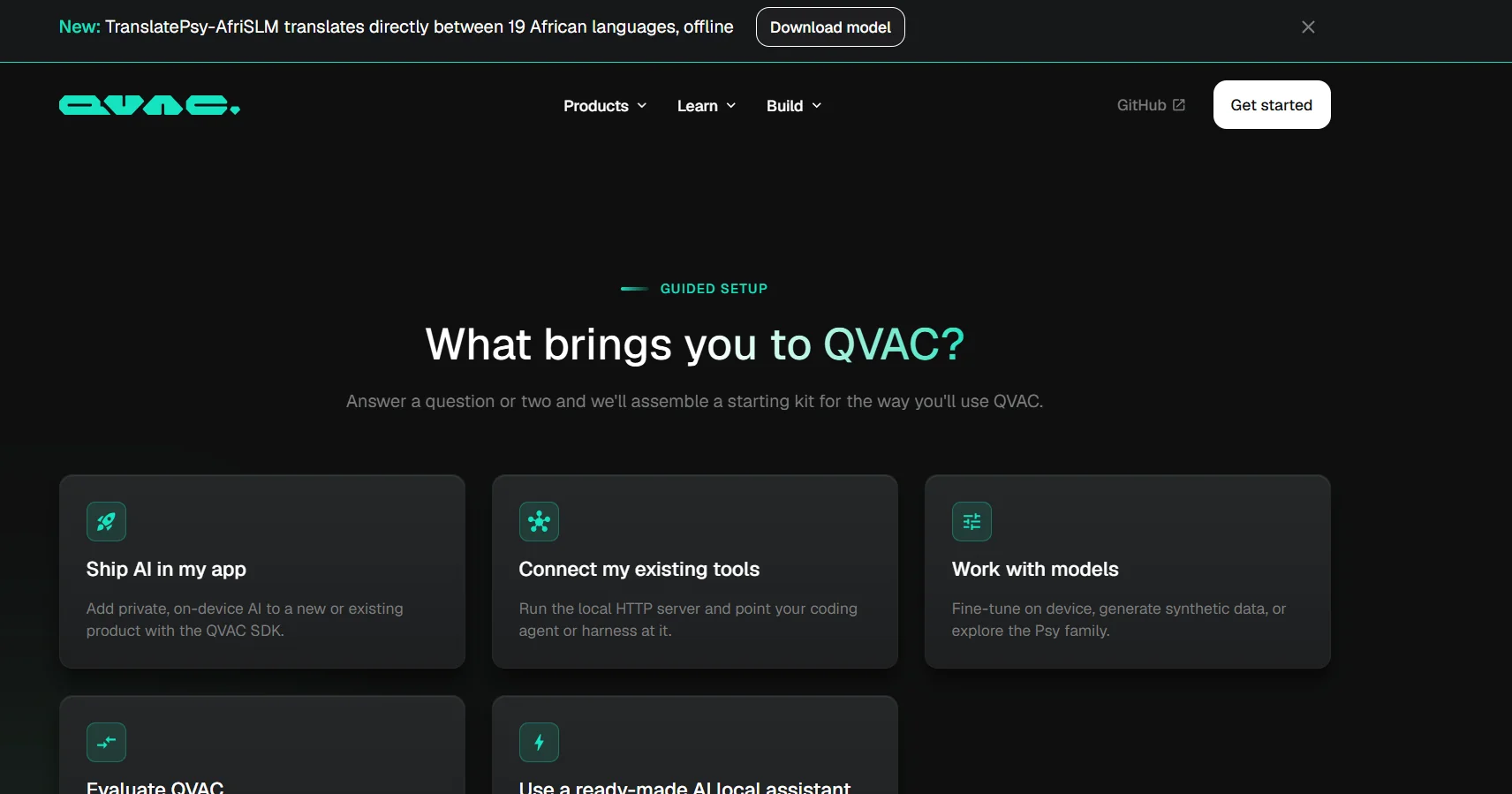
QVAC is an SDK and a system for providing AI models locally, enabling the execution of LLM models, speech and vision recognition, image and video generation, and more on any device, It also enables the development of applications for mobile phones and desktop devices or the provision of on-premises models for users’ preferred AI tools. QVAC supports running a comprehensive range of AI workloads locally using open-source models on Linux, macOS, Windows, Android, and iOS systems, and provides an SDK for building applications and systems that prioritize local AI using JavaScript/TypeScript, and Python, as well as an HTTP server for using QVAC as a local model provider, with an OpenAI-compatible API that allows integration with AI tools such as OpenCode, OpenClaw, and any other compatible tool. QVAC is designed to run locally first, so the AI operates offline with inference optimized for commercially available devices, ranging from consumer apps and embedded systems to enterprise deployments, It also provides privacy and control by keeping data local and owning the AI system without the need for the cloud or third-party APIs, and offers a single SDK interface for a comprehensive set of AI capabilities, It supports cross-platform development using a single codebase on Linux, macOS, Windows, Android, and iOS with JavaScript/TypeScript or Python, It also offers peer-to-peer capabilities to transfer AI models directly between devices and build uninterrupted internet systems, similar to BitTorrent or IPFS but for AI. QVAC enables model deployment and inference locally in a few quick steps using JavaScript, Python, or an HTTP server, Its capabilities also include text generation through LLM inference for text and conversation generation via Fabric LLM, as well as text embedding generation for use in semantic search, aggregation, and retrieval, RAG through a pre-built workflow for generating retrieval-augmented answers, fine-tuning LLM models for specialized tasks in specific domains using LoRA, multimodal reasoning on text, images, and other media within a single context; text-to-image and image-to-image generation via the Diffusion backend; and text-to-video and image-to-video generation via the Diffusion backend; music generation from text, lyrics, and musical controls using ACE-Step or MiniMax-Music3 on desktop systems; audio transcription and speech-to-text conversion using the Whisper or NVIDIA Parakeet backend; text-to-speech synthesis via the GGML backend; machine translation using Fabric LLM and Bergamot; audio transcription for brain-computer interfaces (BCIs) using the Whisper and VLA backends; i.e., vision, language, and action for robot control using the GGML backend; optical character recognition (OCR) to extract text from images using the ONNX Runtime or GGML backends; and image classification into labels with confidence scores using the GGML backend. QVAC’s built-in peer-to-peer capabilities enable the construction of uninterrupted internet systems without relying on centralized infrastructure, as AI models can be fetched directly from other devices via a distributed model registry, eliminating the need to host and distribute models through a central entity, The Blind Relays feature also enables traffic to be routed through peer devices acting as relays when devices cannot connect directly due to NAT and firewalls, while maintaining network connectivity without a centralized infrastructure. QVAC resources include comprehensive documentation, examples that include experimental applications and proofs of concept built using the QVAC SDK, the Local Model Provider for using QVAC as a local model provider connected to the user’s preferred AI tools, and QV.AC to learn about the local AI assistant; support and community via Discord and Keet to get help, provide feedback, and discuss QVAC; and a blog featuring tutorials, in-depth analyses, engineering insights, and announcements; the Ecosystem section to explore the broader QVAC ecosystem; the Research section, which includes research papers, datasets, and optimized models for edge devices; and the Our Vision section to learn why Tether built the QVAC platform. The project welcomes contributions by opening pull requests, reporting bugs, or sharing ideas via Issues. It also provides badges that can be added to the README files of projects built using QVAC to help others discover them, with a full set of badges available, including light and dark mode versions, as well as embedded badges with copy-ready snippets in the BADGES.md file. The project describes itself as an open-source SDK for on-device AI that enables AI to run on the device without the cloud or APIs, and supports GGUF, RAG, image, music, and video generation, speech-to-text, peer-to-peer inference, and more, with support for Linux, macOS, Windows, Android, and iOS. The repository is licensed under the Apache-2.0 license, has 602 stars, 3 watchers, and 112 forks, and contains 32 releases, the latest of which is QVAC SDK v0.19.1, released yesterday. The repository has 80 contributors, and the language breakdown is 39% TypeScript, 28.3% JavaScript, 21.8% C++, Python at 9.3%, Shell at 0.8%, CMake at 0.6%, and other languages at 0.2%. The project is copyrighted © 2026 GitHub, Inc.