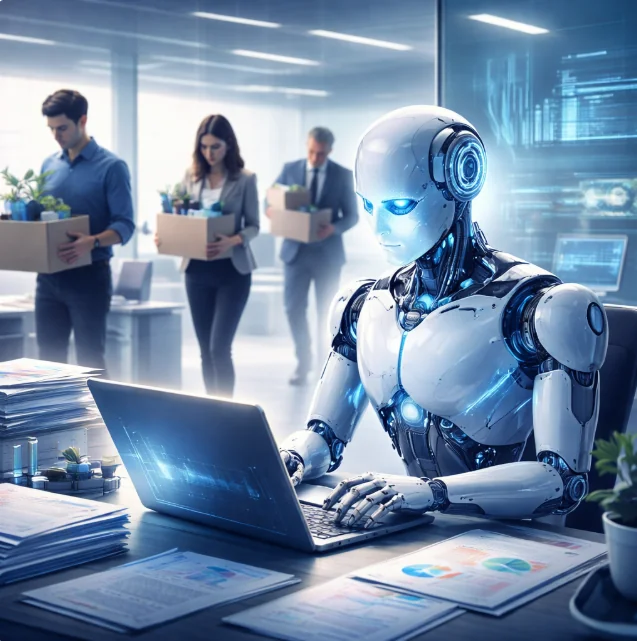
Over the past year, many corporate leaders in the United States have justified waves of layoffs by saying that artificial intelligence has made many jobs unnecessary and that new technologies are now capable of performing tasks that were previously done by humans. However, a number of economists and technology analysts have expressed skepticism about these justifications, arguing that the real reasons behind the workforce reductions are other factors such as the impact of tariffs, overhiring during the COVID-19 pandemic, and companies' efforts to increase profits.
Some experts describe this phenomenon as "AI washing," or using artificial intelligence as a propaganda excuse to justify difficult management decisions. Fabian Stefani, a researcher at the Oxford Internet Institute, explains that CEOs can claim that they are adopting the latest technologies and transforming their companies into more advanced entities, thereby justifying layoffs on the grounds of keeping up with the digital age.
According to a December report by consulting firm Challenger, Gray & Christmas, artificial intelligence was cited as the direct cause of more than 54,000 layoffs in 2025 alone. Last January, Amazon laid off about 16,000 employees after cutting another 14,000 jobs in October. Beth Galetti, the company's vice president, explained that artificial intelligence is the most transformative technology since the advent of the internet, forcing companies to become more efficient and less dependent on labor.
Enrique Lores, CEO of Hewlett Packard, also indicated that his company intends to use artificial intelligence to improve productivity and customer satisfaction, which could lead to the loss of about 6,000 jobs in the coming years. In the same vein, Luis von Ahn, CEO of the language learning app Duolingo, announced that the company will gradually stop relying on contractors to perform tasks that can be done by artificial intelligence.
However, a report by research firm Forrester asserts that the real motivation behind most layoffs is primarily financial, and that only 6% of jobs can be fully automated by 2030. JP Gownder, a principal analyst at the firm, believes that many executives are overestimating the current capabilities of AI and are trying to replace employees with immature systems that may take years to become truly capable of performing the required work.
Economist Martha Gimmel of Yale University points out that blaming AI for layoffs seems illogical, especially since the technology is still relatively new and it has only been three years since tools such as ChatGPT became widespread. She explains that the adoption of any new technology does not usually lead to immediate changes in the labor market, and that adapting to it takes a long time.
Other analysts believe that some companies prefer to attribute their decisions to AI rather than acknowledge the impact of economic policies such as tariffs or hiring mistakes during the pandemic. Referring to AI seems less politically sensitive, and companies avoid clashes with the US administration or public opinion.
However, experts acknowledge that there are limited cases where AI is indeed a logical reason for job cuts, particularly in areas such as customer service and online technical support. For example, Marc Benioff, CEO of Salesforce, stated that he reduced the number of customer service employees from 9,000 to 5,000 after relying on AI agents capable of performing most tasks.
However, Martha Gimmel warns against relying solely on CEOs' statements to understand the impact of technology on the job market, noting that they have informational and financial incentives that sometimes lead them to present simplified or misleading narratives. This contradiction was clearly evident when Andy Jassy, CEO of Amazon, backtracked on a previous statement linking layoffs to AI, later asserting that the decision was related to work culture rather than technology.
A former Amazon employee, who used AI tools extensively in her work, also confirmed that she did not believe technology was the real reason behind her layoff, but rather that the goal was to reduce labor costs and replace her with lower-paid employees. Her experience shows that AI may be a helpful tool, but it is still far from being a complete replacement for human expertise.
While the debate continues about the real role of AI in changing the job market, experts agree that its actual impact remains limited compared to traditional economic factors, and that its use as a ready-made excuse to justify layoffs often reflects a public relations strategy rather than a tangible technological reality.