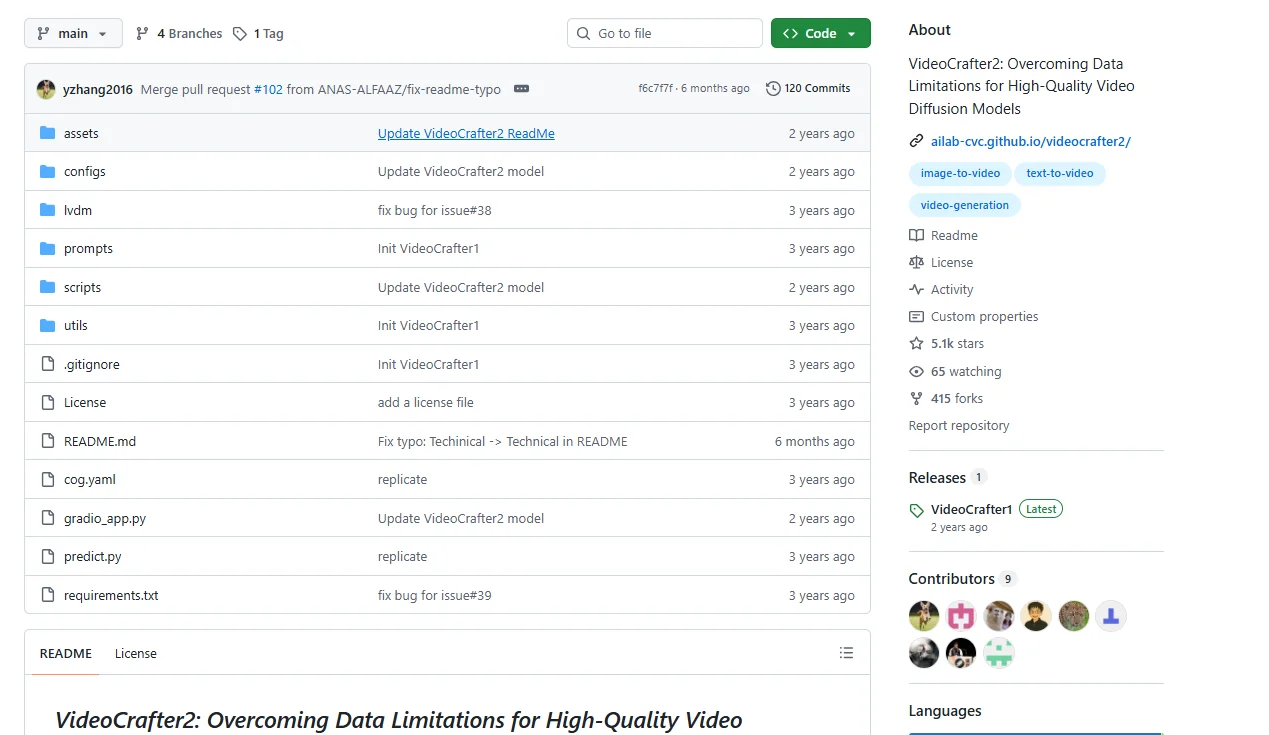
Description

️ 🖼Tool Name:
VideoCrafter

🔖 Categories:

  • Text and Photos to Video
  • Video, Editing, and Motion Graphics
  • Generate Images from Text
  • Image Design and Creation
  • Video Ideas and Scripts
  • Programming and Development
  • Databases and Modeling
  • Editing/Optimization/Up-scaling

️ ✏What does this tool offer?

VideoCrafter offers a set of open-source tools for creating and editing videos using artificial intelligence, relying on Video Diffusion Models to generate visual content from text and images. The project was developed by the AILab-CVCteam and aims to provide open-source models for generating high-quality video for research and development purposes.

The platform includes core models for video generation, most notably:

  • Text-to-Video (T2V):
    Generates videos based on text prompts, where the user writes a description of a scene to be converted into an AI-generated video.
  • Image-to-Video (I2V):
    Converting still images into videos while preserving the image’s content, structure, and style during motion.

The project provides models such as:

  • VideoCrafter1.
  • VideoCrafter2.

with improvements in video quality, motion, concept integration, and training efficiency compared to previous versions.

The project also provides:

  • Training code.
  • Model inference code.
  • Configuration files.
  • Ready-to-use models.
  • A local demo app using Gradio.

What does it actually offer based on user experience?

  • Creating videos from text using AI.
  • Converting images into animated videos.
  • Creating cinematic-style videos from text descriptions.
  • Preserving image content when converting it to video.
  • Providing open-source models for researchers and developers.
  • Ability to run and modify the model locally.
  • Provide training and inference code.
  • Support the development of custom applications built on video generation models.

🤖 Does it include automation?

Yes, VideoCrafter includes automated processes related to AI-powered video generation.

Automation includes:

  • Automatically generating videos from text.
  • Converting images into videos.
  • Performing inferences using predefined commands.
  • Processing models and data using software workflows.
  • Running a demo app to create videos using Gradio.

💰 Pricing model:

Free and open source

VideoCrafter does not offer paid subscriptions; the code and templates are provided via GitHub. Commercial use is subject to the project’s license terms, as the repository states that the project is intended for research and personal, non-commercial use.

🆓 Free Plan Details:

FeatureDetails
Usage TypeOpen-source project
Price$0
AccessAvailable on GitHub
TemplatesVideoCrafter1 and VideoCrafter2
FunctionsText-to-Video and Image-to-Video
CodeTraining and inference code available
UsageResearch, development, and personal experiments
LicenseApache 2.0, according to the project page and official website

💳 Paid plan details:

PlanPriceFeatures
No paid plansNot availableThe project is open source and does not offer paid subscriptions

Note: Running models may require computing resources such as GPUs, depending on the model size and runtime requirements.

🧭 How to access the tool:

MethodDetails
GitHubAccess the source code and models
Local executionSet up the environment and run the models on your device
Gradio DemoRun a local demo interface
Hugging FaceDownload some pre-trained models
APINo commercial API is mentioned

🔗 Demo link or official website:
https://github.com/AILab-CVC/VideoCrafter

Pricing Details

The VideoCrafter tool is available through its open-source repository on GitHub, where users can download the project’s code and models and run them locally or use them within appropriate development environments. The tool provides the VideoCrafter1 and VideoCrafter2 models for generating video from text (Text-to-Video) and converting images to video (Image-to-Video), with access to the training and inference code. Powerful computing resources, such as GPUs, are recommended for running the models efficiently, while adhering to the licensing and usage terms specified by the project.